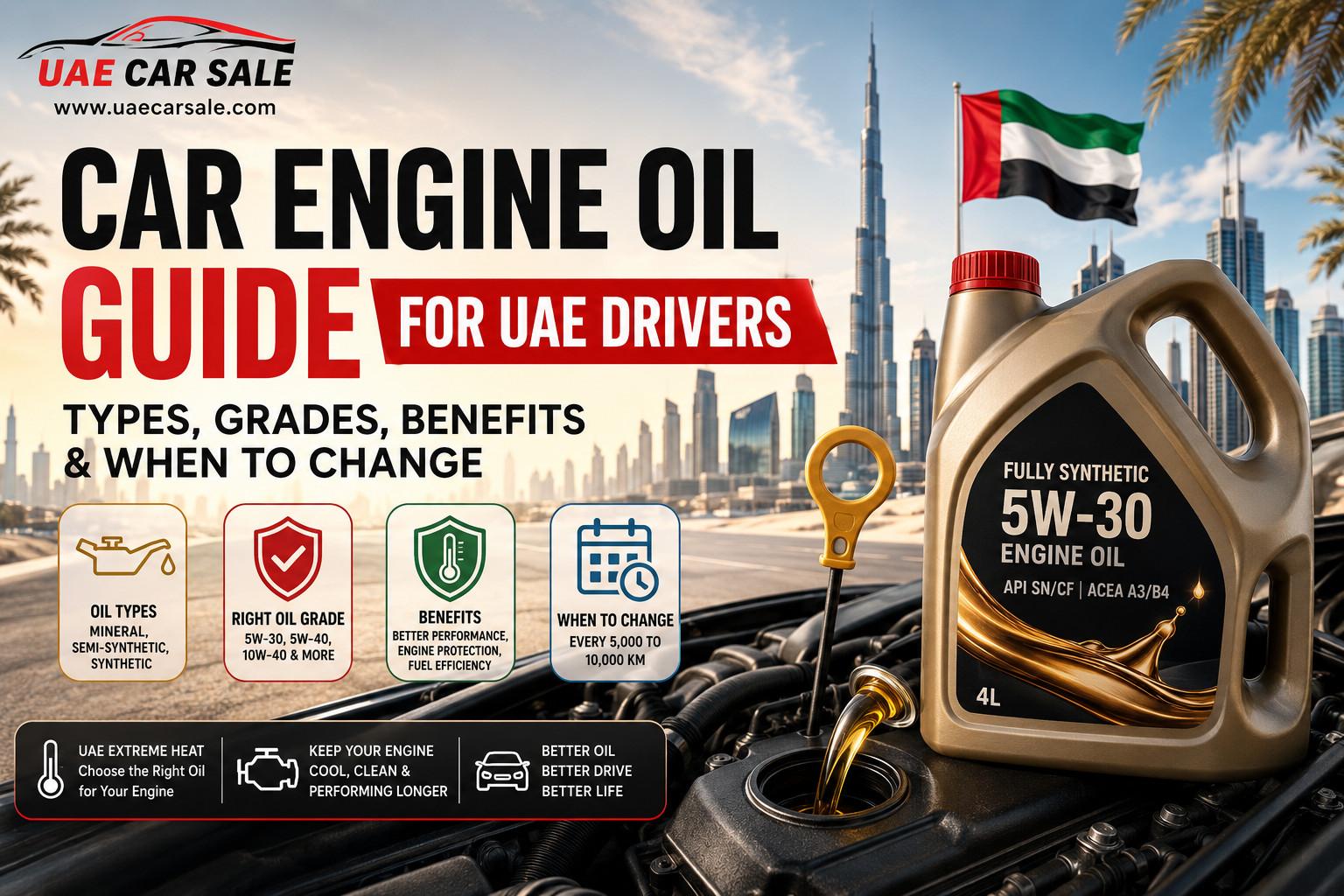

Car engine oil is one of the most important fluids in your vehicle. It lubricates the engine’s moving parts, helps control heat, reduces friction and protects critical components from wear.
For drivers in the UAE, choosing and maintaining the correct engine oil is especially important. High temperatures, heavy traffic, frequent stop-and-go driving and long-distance journeys can place additional demands on your vehicle’s engine.
In this complete guide, we explain types of car engine oil, engine oil grades, synthetic vs mineral oil, when to change engine oil, warning signs and how to choose the right oil for your car in the UAE.
What Is Car Engine Oil?
Car engine oil is a specially formulated lubricant designed to protect the internal components of an engine.
Inside an engine, components such as pistons, bearings, camshafts and other moving parts operate at high speed and temperature. Engine oil creates a protective lubricating layer between these components to help reduce friction and wear.
Engine oil also helps:
- Reduce friction between moving engine parts
- Protect against engine wear
- Help control engine temperature
- Carry contaminants toward the oil filter
- Reduce corrosion
- Support smooth engine operation
- Protect engine components during demanding driving conditions
Why Is Engine Oil Important in the UAE?
The UAE’s hot climate makes proper vehicle maintenance particularly important.
During summer, high outside temperatures combined with engine operating temperatures can place significant thermal demands on the vehicle. Heavy traffic and extended idling can add further stress.
Regular engine oil maintenance can help your vehicle operate reliably.
UAE driving conditions that may put additional demands on an engine include:
- High summer temperatures
- Heavy city traffic
- Frequent stop-and-go driving
- Long highway journeys
- Extended engine idling
- Frequent short trips
- Dusty environments
- Towing or carrying heavy loads
However, hot weather does not automatically mean you should use a thicker engine oil. Always follow the vehicle manufacturer’s recommended oil specification.
Types of Car Engine Oil
There are several types of engine oil available for modern and older vehicles. The correct choice depends on your vehicle’s engine, manufacturer requirements, driving conditions and required oil specification.
1. Mineral Engine Oil
Mineral engine oil is produced from refined petroleum and is one of the traditional types of engine oil.
It is generally less expensive than synthetic oil and may be suitable for certain older engines.
Advantages of Mineral Oil
- Usually more affordable
- Suitable for some older engines
- Widely available
- Can be appropriate for engines designed for conventional oil
Disadvantages
- Generally offers less advanced performance than modern synthetic oils
- May have lower resistance to extreme operating conditions
- May require more frequent replacement depending on the vehicle
Always check your owner’s manual before using mineral engine oil.
2. Semi-Synthetic Engine Oil
Semi-synthetic engine oil, also known as synthetic-blend oil, combines mineral oil with synthetic components.
It can provide a balance between cost and performance.
Advantages
- Good balance between price and performance
- Better protection than basic mineral oil in many applications
- Suitable for many vehicles when approved by the manufacturer
The exact performance of semi-synthetic oil varies by product, so always check the specifications printed on the container.
3. Fully Synthetic Engine Oil
Fully synthetic engine oil is engineered to provide consistent lubrication and performance over a broad temperature range.
It is commonly specified for many modern vehicles.
Benefits of Fully Synthetic Oil
- Strong high-temperature performance
- Good resistance to oxidation
- Consistent lubrication
- Excellent engine protection
- Can support manufacturer-approved longer service intervals
- Often performs well under demanding driving conditions
However, fully synthetic oil is not automatically the correct choice for every vehicle. The manufacturer’s required specification is more important than simply choosing synthetic oil.
4. High-Mileage Engine Oil
High-mileage engine oils are formulated for vehicles with higher odometer readings.
These oils may contain additives designed to support aging engine components and seals.
Potential Benefits
- Helps support aging engine seals
- May help reduce minor oil consumption in some engines
- Provides protection suited to older engines
High-mileage oil is not automatically necessary simply because a vehicle has high mileage. Follow the manufacturer’s recommendations.
5. Diesel Engine Oil
Diesel engines can require engine oils with specific performance standards because diesel combustion and engine operating conditions can differ from petrol engines.
Diesel engine oil may have specifications designed to deal with the operating requirements of diesel engines.
If you own a diesel vehicle, always use an oil that meets the exact specification required by the manufacturer.
6. Petrol Engine Oil
Petrol engines can require oils designed to meet specific gasoline-engine performance standards.
Modern petrol engines can have very different requirements depending on their design, turbocharging, fuel-injection system and emissions equipment.
Always check your vehicle manufacturer’s recommended oil specification.
7. Low-Viscosity Engine Oil
Modern engines increasingly use lower-viscosity oils such as:
- 0W-20
- 0W-30
- 5W-20
- 5W-30
These oils can help reduce internal friction and support fuel efficiency when they are approved for the engine.
Do not choose a low-viscosity oil simply because it is marketed as fuel-efficient.
Use the viscosity specified by your vehicle manufacturer.
8. Turbo Engine Oil
Turbocharged engines can operate under high temperatures and pressures. Some manufacturers therefore require specific engine oils that meet particular performance standards for turbocharged engines.
If your vehicle has a turbocharged engine, check the owner’s manual for the correct oil viscosity and specification.
9. Engine Oil for Hybrid Cars
Hybrid vehicles can have specific engine-oil requirements because their petrol engine may start and stop frequently.
Some hybrid engines require low-viscosity synthetic oils that meet specific manufacturer standards.
Always check the vehicle manufacturer’s recommendation before selecting oil for a hybrid vehicle.
What Do Engine Oil Grades Mean?
You may see engine oil grades such as:
- 0W-20
- 0W-30
- 5W-20
- 5W-30
- 5W-40
- 10W-40
- 15W-40
These numbers describe the oil’s viscosity characteristics.
For example, in 5W-30:
- 5W indicates the oil’s viscosity performance at lower temperatures.
- 30 indicates its viscosity at normal engine operating temperature.
- W stands for winter.
The viscosity grade does not tell you whether one oil is universally better than another.
For example, 5W-30 is not automatically better than 5W-40. The correct grade depends on your vehicle.
Common Engine Oil Grades Explained
0W-20
A low-viscosity oil commonly specified for certain modern petrol and hybrid engines.
5W-20
Another low-viscosity grade used in some modern engines.
5W-30
A widely used viscosity grade for many modern petrol and diesel vehicles.
5W-40
A slightly higher operating-temperature viscosity than 5W-30 and used by many vehicles where specified.
10W-40
A common viscosity grade for certain older or specific engine applications.
15W-40
Often used in certain diesel engines and other applications where the manufacturer specifies it.
Important: These are general examples. Always use the exact viscosity and specification recommended for your vehicle.
Which Engine Oil Is Best for Your Car?
There is no single engine oil that is best for every vehicle.
The correct engine oil depends on:
- Vehicle make
- Vehicle model
- Model year
- Engine type
- Petrol or diesel engine
- Hybrid or conventional powertrain
- Engine mileage
- Manufacturer specification
- Required viscosity
- Driving conditions
The best approach is to check your vehicle owner’s manual or the manufacturer’s official service information.
How Often Should You Change Engine Oil?
The correct engine oil change interval depends on your vehicle, engine and oil specification.
Some modern vehicles can travel significantly longer between oil changes than older vehicles.
Your manufacturer’s maintenance schedule should be the primary reference.
You may need to pay particular attention to your maintenance schedule if your vehicle regularly experiences demanding conditions such as:
- Heavy traffic
- Frequent short journeys
- Extended idling
- High temperatures
- Towing
- Heavy loads
- Frequent stop-and-go driving
- Dusty environments
Do not rely only on a generic mileage number because oil-change requirements vary between vehicles.
Signs Your Car May Need an Oil Change
Several signs may indicate an engine oil or engine-related problem.
1. Oil Warning Light
If the oil pressure warning light appears on the dashboard, do not ignore it.
Stop the vehicle safely and have the problem investigated promptly.
An oil warning light can indicate low oil pressure or another serious engine issue.
2. Low Engine Oil Level
A low oil level may result from an oil leak, oil consumption or insufficient maintenance.
Check the oil level according to your vehicle manufacturer’s instructions.
3. Unusual Engine Noise
Unusual knocking, ticking or other engine noises should not be ignored.
Poor lubrication or low oil pressure can contribute to engine damage.
Have the vehicle inspected by a qualified technician.
4. Burning Oil Smell
A burning oil smell can indicate an oil leak or oil contacting a hot engine component.
This should be checked as soon as possible.
5. Oil Leaks
Oil spots underneath your parked vehicle may indicate a leak.
Do not ignore repeated oil leaks because low oil levels can cause serious engine problems.
6. Increased Oil Consumption
If you need to add engine oil frequently, your vehicle may have an oil leak or excessive oil consumption.
A qualified technician should inspect the vehicle to identify the cause.
How to Check Your Engine Oil
If your vehicle has a traditional oil dipstick, you can usually check the engine oil level by following these steps:
- Park your car on a level surface.
- Switch off the engine.
- Allow the engine to cool for the period recommended by the manufacturer.
- Open the bonnet.
- Locate the engine oil dipstick.
- Remove and wipe the dipstick clean.
- Reinsert it completely.
- Remove it again and check the oil level.
- Make sure the oil level is within the recommended range.
Some modern vehicles do not have a traditional dipstick and instead use an electronic oil-level monitoring system.
Always follow your vehicle manufacturer’s instructions.
Can You Mix Different Engine Oils?
It is best to avoid mixing different oils unnecessarily.
If you need to top up engine oil, use a product that meets the correct viscosity and performance specification for your vehicle.
If you are unsure whether two oils are compatible, check your owner’s manual or ask a qualified automotive professional.
Does Expensive Engine Oil Mean Better Protection?
Not necessarily.
The most expensive engine oil is not automatically the best oil for your vehicle.
The most important factors are:
- Correct viscosity
- Correct performance specification
- Manufacturer approval where required
- Correct application
- Genuine product
- Appropriate service interval
Always choose an oil that meets your vehicle manufacturer’s requirements.
Engine Oil Filter: Why Is It Important?
The engine oil filter removes contaminants from the oil as it circulates through the engine.
A clogged or old oil filter can affect oil flow and filtration performance.
For this reason, the oil filter is commonly replaced during an engine oil service, depending on the vehicle manufacturer’s maintenance schedule.
Engine Oil Tips for UAE Drivers
Here are some useful engine oil maintenance tips for UAE motorists:
- Check your engine oil level regularly.
- Use the recommended engine oil grade.
- Follow your manufacturer’s service schedule.
- Do not ignore the oil warning light.
- Check your vehicle for oil leaks.
- Use genuine, quality engine oil.
- Replace the oil filter according to the maintenance schedule.
- Pay attention to unusual engine noises.
- Check your oil before long road trips.
- Keep records of your vehicle’s oil changes.
- Have your vehicle inspected if it is consuming excessive oil.
What Happens If You Don’t Change Engine Oil?
Engine oil becomes contaminated as it circulates through an engine.
Over time, the oil’s ability to provide the required protection can be affected. Continuing to drive beyond the manufacturer’s recommended maintenance schedule can increase the risk of engine wear and other problems.
Neglecting engine oil maintenance can eventually result in expensive repairs.
Regular servicing is generally far less costly than repairing a severely damaged engine.
Engine Oil and Fuel Economy
Using the correct engine oil can support efficient engine operation.
Some modern engines are specifically designed to use low-viscosity oils to reduce internal friction and support fuel efficiency.
However, using an oil that is too thin or too thick for your engine can be inappropriate.
For the best results, always use the oil grade and specification recommended by the vehicle manufacturer.
How to Choose the Right Engine Oil in the UAE
Before purchasing engine oil, check these five things:
1. Check the Owner’s Manual
Look for the recommended viscosity and performance specification.
2. Check the Oil Grade
Confirm that the viscosity, such as 5W-30 or 5W-40, matches your vehicle’s requirements.
3. Check the Performance Specification
Do not focus only on the viscosity. The required industry and manufacturer specifications are also important.
4. Buy From a Reliable Source
Purchase genuine engine oil from reputable automotive stores, service centres or authorized suppliers.
5. Follow the Correct Service Interval
Even high-quality engine oil needs to be replaced according to the vehicle manufacturer’s maintenance schedule.
Frequently Asked Questions About Car Engine Oil
How often should I change my car engine oil in the UAE?
Follow your vehicle manufacturer’s recommended service interval. Driving conditions, engine type and oil specification can affect the required maintenance schedule.
Which engine oil is best for hot weather in the UAE?
There is no universal engine oil that is best for all UAE vehicles. Use the viscosity and performance specification recommended by your vehicle manufacturer.
Is fully synthetic oil better than mineral oil?
Fully synthetic oil generally provides more advanced performance characteristics, but the correct choice depends on your vehicle manufacturer’s requirements.
Is 5W-30 better than 5W-40?
Neither is universally better. Your vehicle manufacturer determines which viscosity is appropriate for your engine.
Can I use 10W-40 instead of 5W-30?
Only if the alternative viscosity is approved for your specific vehicle and engine. Always check the manufacturer’s recommendations first.
How do I know if my engine oil is low?
Use the dipstick if your vehicle has one, or follow the manufacturer’s instructions for checking the electronic oil-level system.
Can low engine oil damage my engine?
Yes. Insufficient engine oil can reduce lubrication and may cause serious engine damage.
Can I drive if the oil warning light comes on?
Do not continue driving unnecessarily when an oil pressure warning light is illuminated. Stop safely and have the vehicle checked.
Should I change the oil filter when changing engine oil?
In many vehicles, the oil filter is replaced during an oil service. Follow your vehicle manufacturer’s maintenance recommendations.
Is synthetic oil suitable for all cars?
No. The correct oil depends on the vehicle and engine. Always use an oil that meets the manufacturer’s required specification.
Find Auto Services, Cars & Deals in the UAE
Looking for an engine oil change, garage, auto repair centre, spare parts shop or other automotive service in the UAE?
Explore UAECarSale.com to find automotive businesses and services across the UAE.
You can also browse:
- New & Used Cars for Sale
- Auto Businesses
- Auto Deals & Offers
- Car Service Centres
- Garages & Repair Shops
- Tyre Shops
- Spare Parts & Accessories Businesses
- Car Wash & Detailing Services
Whether you are looking to buy a car, sell your vehicle, find an automotive business or discover the latest auto deals and offers in the UAE, UAECarSale.com brings automotive services and opportunities together in one platform.
Final Thoughts
Choosing the correct car engine oil is an important part of maintaining your vehicle.
For UAE drivers, regular maintenance can be particularly important because of high temperatures, heavy traffic and demanding driving conditions.
Remember that the best engine oil is not necessarily the most expensive or the thickest oil. The right choice is the oil that meets your vehicle manufacturer’s recommended viscosity and performance specifications.
Check your oil level regularly, follow the correct service schedule and address warning signs early to help keep your engine running smoothly.
Looking for cars, automotive businesses or the latest Auto Deals & Offers in the UAE? Visit UAECarSale.com.