

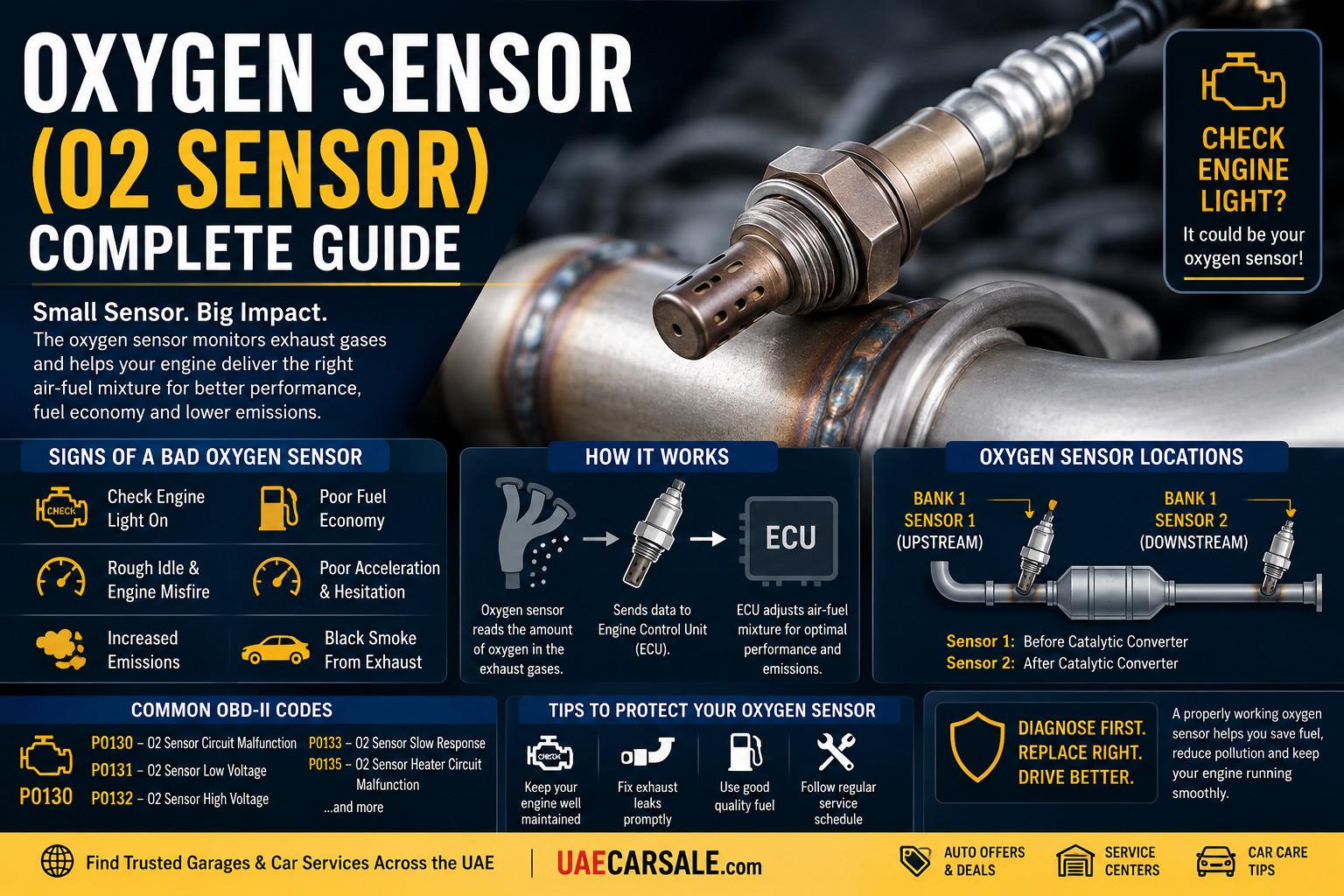
Oxygen Sensor (O2 Sensor) Complete Guide to Function, Symptoms, Problems and Replacement in the UAE

What Is an Oxygen Sensor in a Car?
An oxygen sensor, commonly called an O2 sensor or lambda sensor, is an important component of a modern vehicle’s engine management and exhaust system.
Its primary job is to measure the amount of oxygen present in the exhaust gases and send information to the vehicle’s engine control unit (ECU). The ECU uses this information to help control the air-fuel mixture and maintain efficient engine operation.
Although the oxygen sensor is a relatively small component, a problem with it can affect:
- Fuel economy
- Engine performance
- Air-fuel mixture
- Exhaust emissions
- Engine smoothness
- Check Engine warning light
- Catalytic converter performance
For UAE drivers who regularly deal with high temperatures, heavy traffic and long-distance driving, understanding oxygen sensor problems can help identify engine issues early.
How Does an Oxygen Sensor Work?
The oxygen sensor is installed in the vehicle’s exhaust system where it can measure oxygen in the exhaust gases.
The sensor sends information to the ECU about whether the combustion mixture is relatively rich or lean.
- Rich mixture: Too much fuel compared with available oxygen.
- Lean mixture: Too much oxygen compared with fuel.
The ECU can then use the sensor information to make adjustments to fuel delivery and engine management.
DENSO explains that oxygen sensors monitor the air-fuel mixture during conditions such as idle, moderate acceleration and cruising.
Modern wideband oxygen sensors can provide more precise information about oxygen concentration and air-fuel conditions than traditional switching-type sensors.
Where Is the Oxygen Sensor Located?
The exact location depends on the vehicle’s engine and exhaust design.
Oxygen sensors are commonly installed:
- Before the catalytic converter
- After the catalytic converter
- In some vehicles, at multiple locations within the exhaust system
The sensor before the catalytic converter is commonly referred to as Sensor 1, while the sensor after the catalytic converter is commonly referred to as Sensor 2.
On engines with multiple cylinder banks, you may also see terms such as:
- Bank 1
- Bank 2
- Sensor 1
- Sensor 2
For example:
Bank 1 Sensor 1 (B1S1) generally refers to the upstream oxygen sensor on Bank 1.
The exact sensor position should be confirmed using the vehicle’s service information rather than guessing from the code alone. DENSO recommends identifying the engine’s cylinder configuration when locating Bank 1 and Sensor 1.
What Does an Oxygen Sensor Do?
The oxygen sensor performs several important functions in modern engine management.
1. Monitors Exhaust Oxygen
The sensor measures oxygen in the exhaust gases and provides feedback to the ECU.
2. Helps Control the Air-Fuel Mixture
The ECU uses oxygen-sensor information to help adjust fuel delivery.
3. Supports Fuel Efficiency
An accurately functioning engine management system can help maintain an appropriate air-fuel mixture, supporting efficient fuel consumption.
4. Helps Control Emissions
The oxygen sensor contributes to engine and emissions control by providing feedback about combustion conditions.
5. Supports Catalytic Converter Monitoring
In many vehicles, downstream oxygen sensors are used to monitor catalytic-converter performance.
Symptoms of a Bad Oxygen Sensor
A failing oxygen sensor can produce several symptoms. However, these symptoms can also be caused by other engine or exhaust problems.
A proper diagnosis should therefore be performed before replacing the sensor.
1. Check Engine Light
One of the most common warning signs is the Check Engine Light.
The ECU may detect an oxygen-sensor circuit, heater or performance problem and store a diagnostic trouble code.
However, a Check Engine Light does not automatically mean the oxygen sensor itself is faulty. Vacuum leaks, exhaust leaks, fuel-system problems, wiring faults and other engine issues can also produce similar readings. DENSO’s troubleshooting guidance emphasizes systematic diagnosis rather than replacing parts based only on a symptom.
2. Poor Fuel Economy
A faulty oxygen sensor can provide inaccurate information to the engine management system.
This may contribute to an incorrect air-fuel mixture and increased fuel consumption.
If your car suddenly starts using more fuel than normal, the oxygen sensor is one component worth checking—but it should not be assumed to be the only possible cause.
3. Rough Engine Idle
A problem with the oxygen-sensor signal or the underlying air-fuel system can contribute to rough or unstable engine operation.
You may notice:
- Engine vibration at idle
- Uneven RPM
- Rough running at traffic lights
- Occasional hesitation
4. Poor Acceleration
A vehicle with an engine-management problem may hesitate or feel less responsive during acceleration.
Possible causes include:
- Oxygen sensor problems
- Air leaks
- Fuel injector problems
- MAF sensor problems
- MAP sensor problems
- Ignition problems
- Fuel-pressure problems
DENSO lists several potential rich- and lean-condition causes, demonstrating why diagnosis should not focus on the O2 sensor alone.
5. Increased Exhaust Emissions
An oxygen sensor is part of the system used to manage combustion and emissions.
If the sensor or another part of the engine-management system is malfunctioning, emissions performance may be affected.
6. Engine Hesitation or Stalling
In some cases, engine-management problems associated with incorrect air-fuel control can cause hesitation or unstable running.
If your vehicle is stalling, the oxygen sensor should be diagnosed alongside other possible causes rather than replaced automatically.
7. Black or Unusual Exhaust Smoke
Excess fuel can sometimes produce dark exhaust smoke.
A rich-running engine can have many possible causes, including fuel-system, air-measurement, ignition or oxygen-sensor-related problems.
A professional diagnosis is recommended.
Common Oxygen Sensor Problems
An oxygen sensor can experience several types of faults.
Sensor contamination
Contaminants can affect the sensor’s ability to provide accurate readings.
Wiring damage
Damaged wires, connectors or electrical connections can cause sensor-related faults.
Heater circuit failure
Many modern oxygen sensors have an integrated heating element that helps the sensor reach operating temperature quickly.
Exhaust leaks
An exhaust leak near the sensor can introduce outside air and affect the readings.
Engine problems
A sensor may report a rich or lean condition because another engine component is actually causing the problem.
This is why replacing the sensor without diagnosis can sometimes fail to solve the original problem.
Oxygen Sensor OBD-II Codes
A diagnostic scanner may identify oxygen-sensor-related trouble codes.
Some commonly encountered OBD-II codes include:
- P0130 – Oxygen sensor circuit malfunction
- P0131 – Oxygen sensor circuit low voltage
- P0132 – Oxygen sensor circuit high voltage
- P0133 – Oxygen sensor slow response
- P0134 – Oxygen sensor no activity detected
- P0135 – Oxygen sensor heater circuit malfunction
- P0136 – Oxygen sensor circuit malfunction
- P0137 – Oxygen sensor low voltage
- P0138 – Oxygen sensor high voltage
- P0139 – Oxygen sensor slow response
- P0140 – Oxygen sensor no activity detected
- P0141 – Oxygen sensor heater circuit malfunction
Exact code definitions and diagnostic procedures can vary by vehicle manufacturer, so always verify the code against the specific vehicle’s service information.
What Is Bank 1 and Bank 2?
If your car has a V6, V8 or another multi-bank engine configuration, diagnostic scanners may identify Bank 1 and Bank 2.
Bank 1
Bank 1 is the engine bank containing cylinder number 1.
Bank 2
Bank 2 is the opposite cylinder bank.
The sensor may then be identified as:
Bank 1 Sensor 1
or
Bank 1 Sensor 2
The numbering is important because replacing the wrong oxygen sensor can waste time and money.
What Is Sensor 1 and Sensor 2?
Sensor 1 – Upstream
Sensor 1 is generally located before the catalytic converter.
It provides information used for engine air-fuel control in many vehicles.
Sensor 2 – Downstream
Sensor 2 is generally located after the catalytic converter.
It is commonly used to monitor catalytic-converter performance.
The exact configuration depends on the vehicle.
Oxygen Sensor vs Air-Fuel Ratio Sensor
An oxygen sensor and an air-fuel ratio sensor perform related functions, but they are not necessarily the same type of sensor.
Some modern vehicles use wideband air-fuel sensors that provide more precise information than traditional switching oxygen sensors.
DENSO specifically distinguishes between O2 sensors and air/fuel ratio sensors and recommends identifying the correct sensor type before diagnosis or replacement.
Therefore, always use the correct replacement part specified for your vehicle.
How Is an Oxygen Sensor Tested?
Professional diagnosis may include:
- Reading OBD-II trouble codes
- Checking live sensor data
- Inspecting wiring and connectors
- Checking the sensor heater circuit
- Inspecting the exhaust for leaks
- Checking for vacuum or intake leaks
- Checking fuel-system operation
- Comparing sensor behavior with manufacturer specifications
Traditional switching oxygen sensors can show changing voltage behavior under appropriate operating conditions. DENSO describes testing procedures in which a conventional sensor signal can fluctuate within an expected range once operating temperature is reached.
However, not every oxygen sensor uses the same signal strategy, especially modern wideband sensors. Therefore, do not apply a generic voltage test to every sensor.
Can You Drive With a Bad Oxygen Sensor?
You may be able to drive for some time with an oxygen-sensor fault, but ignoring the problem is not recommended.
A faulty sensor or an underlying rich/lean condition can affect:
- Fuel consumption
- Engine performance
- Emissions
- Catalytic-converter operation
If the Check Engine Light is flashing, the engine is misfiring severely, or the vehicle is overheating or losing power, stop driving when it is safe and have the vehicle inspected.
Oxygen Sensor Problems in the UAE
The UAE presents demanding conditions for vehicle owners, including high ambient temperatures, frequent air-conditioning use, heavy traffic and long-distance driving.
These conditions make regular engine and exhaust-system maintenance particularly important.
However, it is important not to assume that UAE heat alone has caused an oxygen-sensor failure.
A proper inspection should check the sensor together with:
- Exhaust leaks
- Wiring
- Connectors
- Engine performance
- Fuel system
- Air intake system
- Catalytic converter
- Other engine sensors
A UAE automotive diagnostic specialist may use an OBD-II scanner and live data to determine whether the oxygen sensor is actually causing the problem.
How Much Does Oxygen Sensor Replacement Cost in the UAE?
The cost of replacing an oxygen sensor in the UAE can vary considerably.
Factors include:
- Vehicle make
- Vehicle model
- Engine type
- Number of oxygen sensors
- OEM or aftermarket part
- Sensor location
- Labor charges
- Diagnostic charges
- Accessibility of the sensor
Luxury and performance vehicles may have higher parts and labor costs than common models.
For an accurate price, get a quote based on your exact vehicle make, model, year and engine.
Avoid choosing the cheapest sensor solely based on price. The replacement sensor must be compatible with the vehicle’s engine-management system.
OEM vs Aftermarket Oxygen Sensors
When replacing an oxygen sensor, vehicle owners may encounter OEM, OE-equivalent and aftermarket options.
OEM Oxygen Sensor
An OEM part is produced for the vehicle manufacturer or according to the manufacturer’s specifications.
Aftermarket Oxygen Sensor
Aftermarket sensors are produced by independent manufacturers.
A high-quality aftermarket sensor can be an appropriate replacement when it matches the vehicle’s required specification.
The important factors include:
- Correct sensor type
- Correct connector
- Correct application
- Appropriate sensor characteristics
- Reliable manufacturer
- Proper installation
DENSO, for example, highlights vehicle-specific connectors and accurate air-fuel monitoring among the features of its oxygen sensors.
How to Protect Your Oxygen Sensor
There is no universal maintenance schedule that guarantees a particular oxygen-sensor lifespan, but you can reduce the risk of related problems by maintaining the vehicle properly.
Follow your vehicle’s service schedule
Regular servicing helps identify engine and exhaust problems early.
Fix exhaust leaks
An exhaust leak near an oxygen sensor can affect readings.
Maintain the engine
Problems such as misfires, excessive oil consumption or incorrect fuel mixture can affect exhaust-system components.
Use the correct replacement parts
Always match the oxygen sensor to your vehicle.
Do not ignore the Check Engine Light
Early diagnosis can prevent a small fault from becoming a larger repair.
When Should You Replace an Oxygen Sensor?
Do not replace an oxygen sensor simply because the vehicle has high mileage.
Replacement should generally be based on:
- Diagnostic results
- Sensor performance
- Manufacturer recommendations
- Stored trouble codes
- Wiring and heater condition
- Overall engine condition
A diagnostic code may identify an oxygen-sensor circuit or performance issue, but the code itself does not always prove that the sensor is defective.
Oxygen Sensor Maintenance Checklist for UAE Drivers
Before replacing an oxygen sensor, check:
-
Check Engine Light
-
OBD-II trouble codes
-
Fuel consumption
-
Engine idle quality
-
Acceleration performance
-
Exhaust leaks
-
Sensor wiring
-
Sensor connector
-
Sensor heater circuit
-
Intake/vacuum leaks
-
Fuel system
-
Catalytic converter
-
Correct replacement part
Frequently Asked Questions About Oxygen Sensors
1. What does an oxygen sensor do in a car?
An oxygen sensor measures oxygen in the exhaust gases and sends information to the ECU. The ECU uses this information to help manage the engine’s air-fuel mixture and emissions system.
2. What are the symptoms of a bad oxygen sensor?
Common symptoms can include a Check Engine Light, poor fuel economy, rough running, hesitation and increased emissions. However, these symptoms can have other causes, so proper diagnosis is important.
3. Can a bad O2 sensor increase fuel consumption?
Yes, an oxygen-sensor problem can contribute to incorrect air-fuel control and increased fuel consumption. Other fuel, air, ignition and engine-management problems can cause similar symptoms.
4. Does an oxygen sensor cause the Check Engine Light?
A faulty oxygen sensor, its heater circuit, wiring or related system problem can trigger a Check Engine Light. However, the light does not automatically mean the sensor itself needs replacement.
5. How many oxygen sensors does a car have?
The number varies by vehicle. Some cars have two sensors, while vehicles with multiple cylinder banks or more complex exhaust systems can have several oxygen or air-fuel sensors.
6. What is Bank 1 Sensor 1?
Bank 1 Sensor 1 generally refers to the upstream oxygen sensor on the engine bank containing cylinder number 1.
7. What is Bank 1 Sensor 2?
Bank 1 Sensor 2 generally refers to the oxygen sensor located downstream of the catalytic converter on Bank 1.
8. Can I drive with an O2 sensor problem?
It may be possible, but driving for an extended period with an unresolved oxygen-sensor or air-fuel problem is not recommended. Have the vehicle diagnosed to identify the actual cause.
9. Can an oxygen sensor be cleaned?
Cleaning is not a reliable solution for every oxygen-sensor fault. If the sensor has an electrical, heater or internal sensing problem, cleaning will not repair it. Diagnosis should determine whether replacement is necessary.
10. How long does an oxygen sensor last?
Oxygen-sensor life varies according to vehicle design, operating conditions, contamination and other engine-related factors. Follow the manufacturer’s recommendations and replace the sensor when testing indicates it is no longer functioning correctly.
11. Is an oxygen sensor the same as a lambda sensor?
Yes. Oxygen sensor, O2 sensor and lambda sensor are commonly used terms for related exhaust oxygen-sensing components.
12. What causes oxygen sensor failure?
Potential causes include contamination, wiring or connector problems, heater failure, exhaust leaks and underlying engine or fuel-system problems. The actual cause should be diagnosed before replacing the part.
13. Is an oxygen sensor important for fuel economy?
Yes. Oxygen-sensor feedback is part of the engine-management system used to control the air-fuel mixture, so sensor performance can affect fuel efficiency.
14. Can an O2 sensor problem damage the catalytic converter?
A prolonged rich-running condition or other unresolved engine-management problem can place additional stress on the catalytic converter. Prompt diagnosis is therefore recommended.
15. Where can I find oxygen sensor repair services in the UAE?
You can explore UAECarSale.com to find automotive businesses, garages, repair centers and other car service providers across the UAE.
Final Thoughts
The oxygen sensor is a small but important part of your vehicle’s engine management and emissions system. By monitoring oxygen in the exhaust, it provides information that helps the ECU manage the air-fuel mixture and engine operation.
A faulty O2 sensor can be associated with symptoms such as poor fuel economy, rough running, hesitation and a Check Engine Light. However, these symptoms can also result from other problems.
For UAE drivers, the best approach is simple:
Diagnose the problem first, identify the correct sensor, and replace it with a compatible quality part.
Regular maintenance and early diagnosis can help keep your vehicle running efficiently and avoid unnecessary repair costs.
Explore UAECarSale.com for cars, automotive businesses, car services, maintenance information and Auto Offers & Deals across the UAE.