

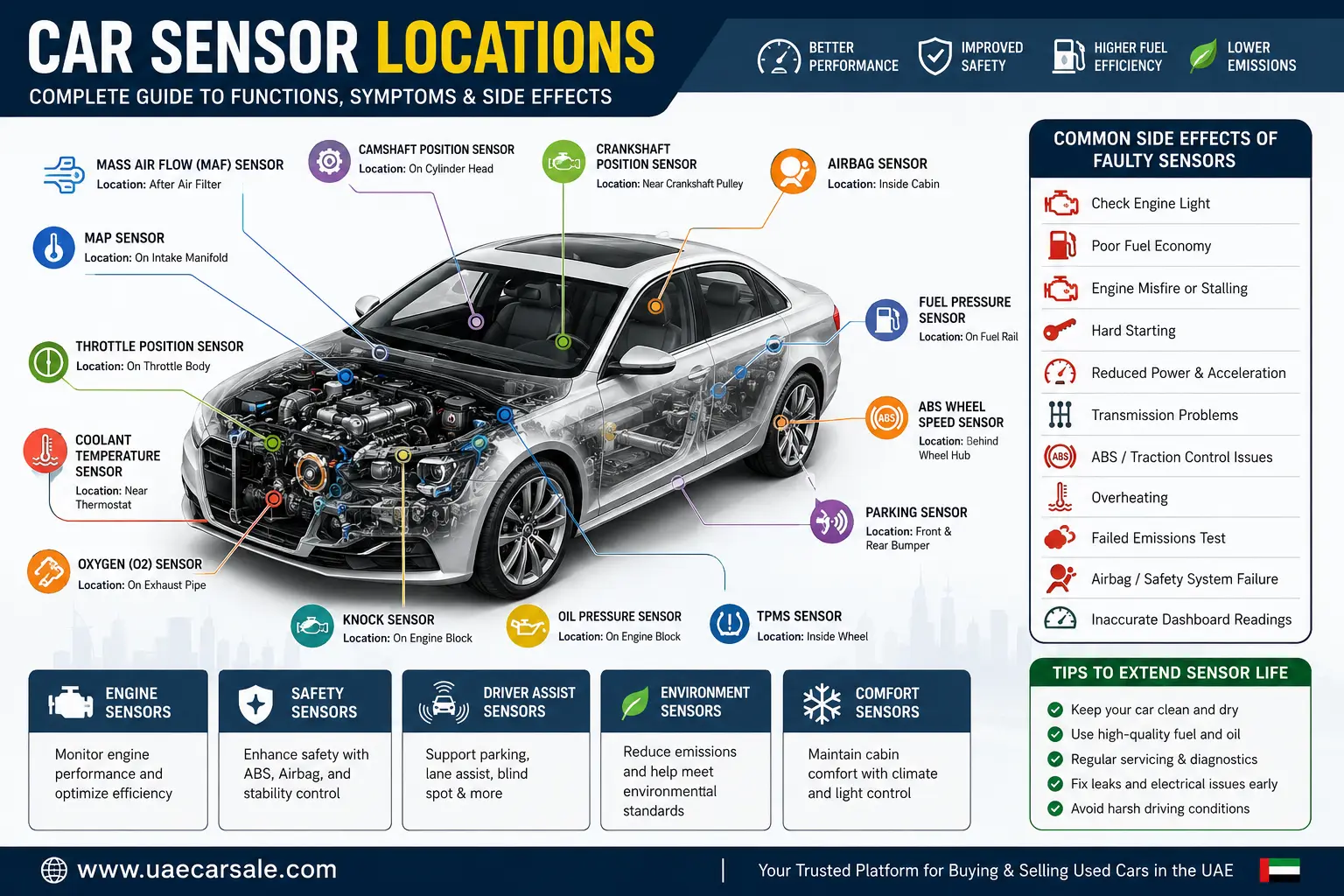
Complete Guide to Car Sensors: Locations, Functions, Symptoms, Side Effects & Maintenance

Modern vehicles contain more than 70 electronic sensors, while luxury vehicles may have over 100 sensors. These sensors continuously monitor engine performance, fuel delivery, braking systems, emissions, climate control, suspension, airbags, and driver assistance systems.
When a sensor fails, your vehicle may experience poor fuel economy, reduced engine power, transmission issues, warning lights, or even complete engine failure.
This guide explains the location, function, symptoms, side effects, causes of failure, and replacement considerations for the most common car sensors.
What Are Car Sensors?
Car sensors are electronic devices that measure temperature, pressure, speed, position, airflow, gases, liquids, and electrical signals. They send real-time information to the Engine Control Unit (ECU), which adjusts engine and vehicle systems for safe and efficient operation.
Without accurate sensor data, modern engines cannot perform correctly.
Engine Sensors
1. Mass Air Flow (MAF) Sensor
Location
Between the air filter box and the engine intake hose.
Function
Measures the amount of air entering the engine to calculate the correct fuel injection.
Symptoms of Failure
- Poor acceleration
- Rough idle
- Black smoke from exhaust
- Poor fuel economy
- Engine hesitation
- Check Engine Light
Side Effects
- Excess fuel consumption
- Carbon buildup
- Reduced engine life
- Increased emissions
2. Manifold Absolute Pressure (MAP) Sensor
Location
Mounted on the intake manifold.
Function
Measures intake manifold pressure to determine engine load.
Symptoms
- Engine stalling
- Hard starting
- Poor acceleration
- Increased fuel consumption
Side Effects
Incorrect air-fuel mixture causing poor engine performance.
3. Oxygen (O2) Sensor
Location
- Before catalytic converter
- After catalytic converter
Function
Measures oxygen in exhaust gases to optimize fuel mixture and emissions.
Symptoms
- Check Engine Light
- High fuel consumption
- Rough idle
- Failed emissions test
Side Effects
- Catalytic converter damage
- Poor fuel economy
- Increased pollution
4. Air Fuel Ratio Sensor
Location
Near the exhaust manifold.
Function
Provides more precise fuel mixture information than a traditional oxygen sensor.
Symptoms
- Engine hesitation
- Poor mileage
- Check Engine Light
5. Throttle Position Sensor (TPS)
Location
Mounted on the throttle body.
Function
Measures throttle opening angle.
Symptoms
- Delayed acceleration
- Transmission shifting issues
- High idle speed
Side Effects
Unsafe acceleration and reduced drivability.
6. Crankshaft Position Sensor
Location
Near the crankshaft pulley or flywheel.
Function
Monitors crankshaft speed and position.
Symptoms
- Engine won’t start
- Random stalling
- Misfire
- Poor acceleration
Side Effects
Complete engine shutdown.
7. Camshaft Position Sensor
Location
Cylinder head.
Function
Controls ignition timing and fuel injection.
Symptoms
- Hard starting
- Engine misfire
- Reduced power
8. Knock Sensor
Location
Engine block.
Function
Detects abnormal engine combustion (knocking).
Symptoms
- Engine knocking
- Reduced power
- Poor fuel economy
9. Coolant Temperature Sensor
Location
Near thermostat housing.
Function
Measures engine coolant temperature.
Symptoms
- Overheating
- Cooling fan problems
- High fuel consumption
10. Oil Pressure Sensor
Location
Engine block.
Function
Monitors engine oil pressure.
Symptoms
- Oil warning light
- Engine noise
- Low oil pressure indication
Side Effects
Severe engine damage if ignored.
11. Intake Air Temperature Sensor
Location
Inside intake pipe or air filter housing.
Function
Measures incoming air temperature.
Symptoms
- Hard starting
- Poor fuel economy
- Rough idle
12. Fuel Pressure Sensor
Location
Fuel rail.
Function
Measures fuel pressure.
Symptoms
- Engine hesitation
- Poor starting
- Low engine power
Exhaust & Emission Sensors
- Oxygen Sensor
- Air Fuel Ratio Sensor
- Exhaust Gas Temperature Sensor
- NOx Sensor
- Differential Pressure Sensor
- EVAP Pressure Sensor
These sensors help reduce emissions and improve fuel efficiency.
Brake & Safety Sensors
ABS Wheel Speed Sensor
Location
Behind each wheel hub.
Function
Measures wheel rotation.
Symptoms
- ABS warning light
- Traction control failure
- Longer stopping distance
Brake Pad Wear Sensor
Location
Inside brake pads.
Function
Alerts when brake pads need replacement.
Brake Fluid Level Sensor
Location
Brake fluid reservoir.
Function
Monitors brake fluid level.
Steering & Suspension Sensors
- Steering Angle Sensor
- Ride Height Sensor
- Suspension Position Sensor
- Yaw Rate Sensor
- Lateral Acceleration Sensor
These are used for Electronic Stability Control (ESC), adaptive suspension, and advanced driver assistance systems.
Transmission Sensors
- Input Speed Sensor
- Output Speed Sensor
- Transmission Temperature Sensor
- Gear Position Sensor
Failure may cause:
- Hard shifting
- Delayed gear changes
- Transmission warning light
- Limp mode
Air Conditioning Sensors
- Cabin Temperature Sensor
- Ambient Temperature Sensor
- Evaporator Temperature Sensor
- Refrigerant Pressure Sensor
- Sunlight Sensor
Parking & Driver Assistance Sensors
Parking Sensors
Located in the front and rear bumpers.
Detect nearby obstacles while parking.
Rain Sensor
Located behind the windshield.
Automatically activates windshield wipers.
Light Sensor
Located near the windshield.
Automatically switches headlights on and off.
Blind Spot Sensor
Located inside the rear bumper.
Monitors vehicles in adjacent lanes.
Radar Sensor
Usually mounted behind the front grille.
Supports adaptive cruise control and emergency braking.
Camera Sensors
Common Locations
- Front grille
- Windshield
- Side mirrors
- Rear tailgate
Used for:
- Lane Keeping Assist
- Traffic Sign Recognition
- 360° Camera
- Parking Assist
Tire Pressure Monitoring Sensor (TPMS)
Location
Inside every wheel.
Function
Measures tire pressure.
Symptoms
- TPMS warning light
- Incorrect tire pressure reading
Battery Management Sensor
Location
Negative battery terminal.
Function
Monitors battery condition.
Symptoms
- Battery warning light
- Charging problems
- Start-stop malfunction
Airbag Sensors
Located throughout the vehicle:
- Front bumper
- Doors
- Pillars
- Seats
Failure may prevent airbags from deploying correctly during a collision.
Common Reasons Car Sensors Fail
- Extreme UAE heat
- Dust and sand
- Water intrusion
- Engine oil leaks
- Electrical corrosion
- Damaged wiring
- Poor-quality replacement parts
- Normal aging and wear
Warning Signs of a Faulty Sensor
- Check Engine Light
- ABS Light
- Airbag Light
- Reduced engine power
- Engine stalling
- Hard starting
- Poor fuel economy
- Rough idle
- Black exhaust smoke
- Transmission shifting problems
- Cooling fan always running
- Engine overheating
Can You Drive with a Bad Sensor?
It depends on the sensor.
Some failed sensors only reduce fuel economy, while others—such as the crankshaft position sensor, oil pressure sensor, ABS wheel speed sensor, or airbag sensors—can affect engine operation or critical safety systems. If a warning light appears or the vehicle behaves abnormally, have it diagnosed as soon as possible.
Tips to Extend Sensor Life
- Replace the engine air filter regularly.
- Keep electrical connectors clean and dry.
- Avoid directing high-pressure water at the engine bay.
- Repair oil and coolant leaks promptly.
- Use quality replacement parts.
- Follow the manufacturer’s maintenance schedule.
- Scan the vehicle periodically with an OBD-II diagnostic tool.
Frequently Asked Questions
How many sensors does a modern car have?
Most modern vehicles have between 70 and 100 sensors, depending on the make, model, and features.
Which sensor is most important?
The crankshaft position sensor, oxygen sensor, MAF sensor, coolant temperature sensor, and ABS wheel speed sensors are among the most critical for vehicle operation and safety.
Can a bad sensor damage my engine?
Yes. Some failed sensors can lead to incorrect fuel delivery, overheating, poor lubrication warnings, or engine knocking, potentially causing expensive damage if ignored.
How do I know which sensor has failed?
A professional diagnostic scan using an OBD-II scanner can identify stored fault codes, which helps pinpoint the affected sensor.
How often should sensors be replaced?
Most sensors do not have a fixed replacement interval. They are typically replaced only when they fail or provide inaccurate readings, though environmental conditions such as heat and dust can shorten their lifespan.
Final Thoughts
Car sensors are the nervous system of today’s vehicles. They help control engine performance, fuel economy, emissions, braking, steering, transmission, and safety features. Understanding where these sensors are located and recognizing the early signs of failure can help you avoid breakdowns and expensive repairs.
If you’re buying or selling a used car in the UAE, always check for warning lights, review the service history, and perform a diagnostic scan before completing the transaction.
Explore thousands of used cars from trusted sellers at www.uaecarsale.com and make informed buying decisions with expert automotive guides and resources.