

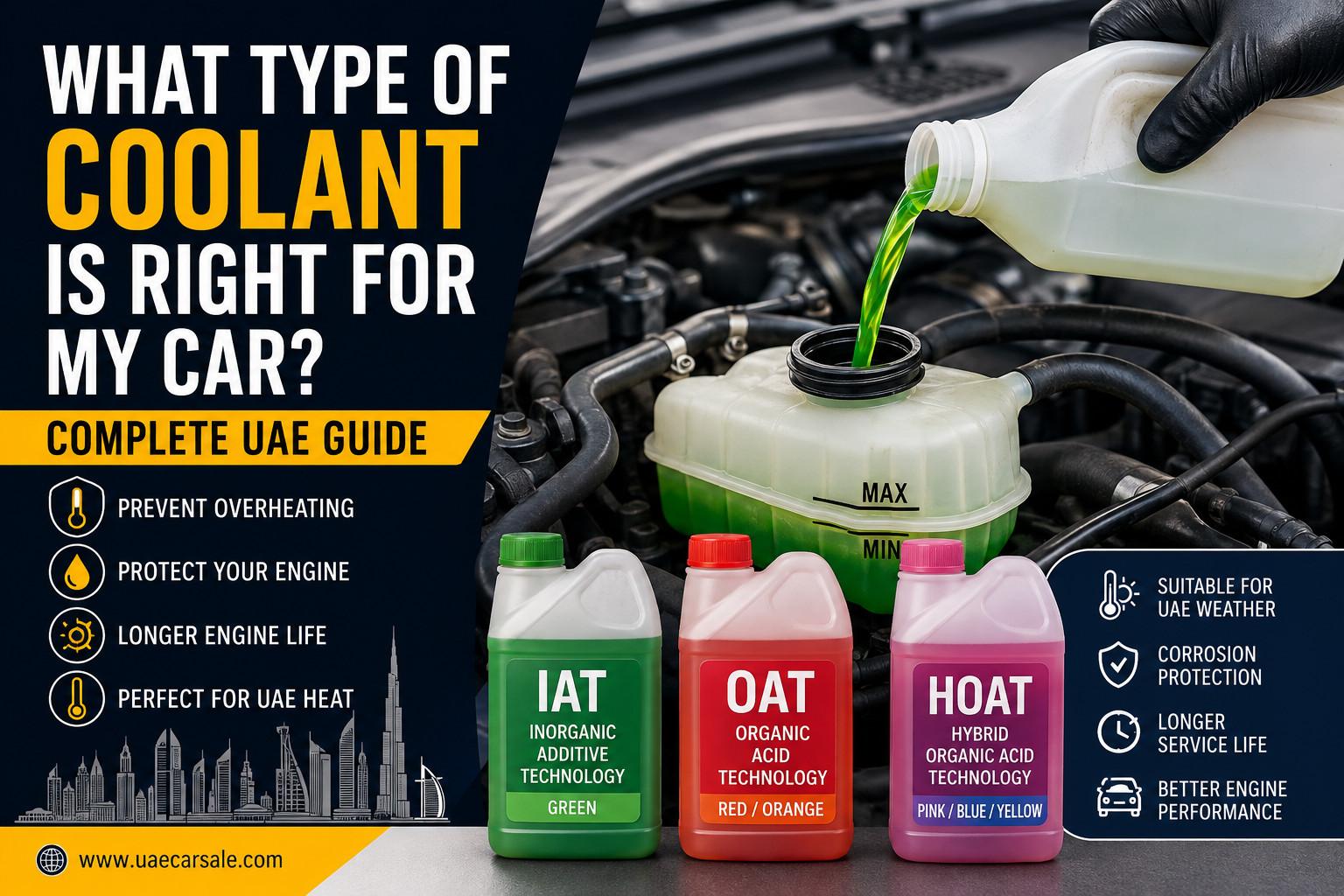

Choosing the right coolant for your car is an important part of vehicle maintenance, especially in the UAE. With extremely hot summer temperatures, your engine cooling system works hard to control engine temperature and prevent overheating.
But which coolant should you use? Is green coolant better than red or pink coolant? What is the difference between IAT, OAT and HOAT coolant? And can you mix different coolant types?
This complete car coolant guide for UAE drivers explains what you need to know before topping up or replacing your engine coolant.
What Is Car Coolant?
Car coolant, also called engine coolant or radiator coolant, is a specially formulated fluid that circulates through the engine and cooling system. It absorbs excess engine heat and transfers it to the radiator, helping maintain a safe operating temperature.
Coolant also contains additives that help protect cooling-system components from corrosion and deposits.
Although coolant is often associated with preventing freezing, it is equally important in hot climates. In the UAE, effective cooling-system maintenance is particularly important because of the high ambient temperatures.
Why Is Coolant Important in the UAE?
Driving in Dubai, Abu Dhabi, Sharjah or other parts of the UAE means your vehicle can regularly operate in very high temperatures.
A properly maintained cooling system helps:
- Control engine temperature
- Reduce the risk of overheating
- Protect the radiator and cooling-system components
- Reduce corrosion inside the cooling system
- Support water-pump and cooling-system performance
- Maintain reliable engine operation
A low coolant level, coolant leak or incorrect coolant can contribute to cooling-system problems.
What Are the Main Types of Car Coolant?
There are several coolant formulations, but three commonly discussed technologies are IAT, OAT and HOAT.
1. IAT Coolant – Inorganic Additive Technology
IAT coolant is an older coolant technology commonly associated with older vehicles.
It uses inorganic corrosion inhibitors such as silicates and phosphates to help protect cooling-system components.
IAT coolant is commonly associated with green coolant, although color should never be used as the only method of identifying the correct coolant.
Typical characteristics:
- Common in older vehicles
- Traditional coolant technology
- Generally requires more frequent replacement
- Provides corrosion protection
If you own an older or classic vehicle, check the owner’s manual before changing coolant technology.
2. OAT Coolant – Organic Acid Technology
OAT coolant uses organic acid corrosion inhibitors and is widely used in many modern vehicles.
OAT coolant can commonly be found in colors such as orange or red, but the color varies between manufacturers.
OAT formulations generally offer longer service life than traditional IAT coolants, depending on the vehicle manufacturer’s specification and maintenance schedule.
Typical characteristics:
- Common in many modern vehicles
- Long-life formulation
- Strong corrosion protection
- Available in different colors depending on manufacturer
3. HOAT Coolant – Hybrid Organic Acid Technology
HOAT coolant combines aspects of traditional inorganic inhibitor technology with organic acid technology.
It is used by various vehicle manufacturers and can be found in different colors, including pink, blue, yellow and others.
HOAT formulations are particularly important because different manufacturers can specify different chemical formulations and approval standards.
Always check the vehicle manufacturer’s specification before selecting a HOAT coolant.
Does Coolant Color Matter?
One of the biggest mistakes car owners make is choosing coolant simply because it has the same color as the coolant already in the reservoir.
Coolant color does not reliably identify compatibility.
Different manufacturers use different dyes, meaning the same color can represent different coolant formulations. Toyota UAE also recommends checking the vehicle’s requirements rather than relying solely on coolant color.
For example:
| Coolant Type | Common Colors* | Typical Use |
|---|---|---|
| IAT | Green | Older vehicles |
| OAT | Red / Orange | Many modern vehicles |
| HOAT | Pink / Blue / Yellow | Various European and Asian vehicles |
*Colors are only general examples and can vary by manufacturer.
The important rule:
Do not choose coolant based only on color. Choose it according to your vehicle manufacturer’s specification.
How Do I Know Which Coolant Is Right for My Car?
The safest way to identify the correct coolant is to check your owner’s manual or the manufacturer’s coolant specification.
Before buying coolant, check:
- Car make
- Model
- Model year
- Engine type
- Manufacturer coolant specification
- Required coolant formulation
- Whether the product is ready-mixed or concentrated
If you are unsure, consult an authorized service center or qualified automotive technician.
Can I Mix Different Coolant Colors?
It is generally not a good idea to mix different coolant formulations simply because they appear to have similar colors.
Different coolant chemistries may not be compatible. Mixing incompatible products can reduce corrosion protection and potentially create cooling-system deposits or other problems.
If you do not know what coolant is currently in your vehicle, it is better to have the cooling system checked before adding a different formulation.
Never assume:
Green + green = compatible
or
Pink + pink = compatible
The chemical specification is more important than the color.
Ready-Mixed vs Concentrated Coolant
Coolant is commonly available as either pre-mixed/ready-to-use coolant or concentrated coolant.
Ready-Mixed Coolant
Ready-mixed coolant has already been prepared at the required concentration.
It is convenient because you can normally use it directly according to the product instructions.
Concentrated Coolant
Concentrated coolant must be diluted according to the vehicle or coolant manufacturer’s instructions, normally using the specified quality of water.
Never guess the mixing ratio.
Always follow the product label and vehicle manufacturer’s requirements.
Can I Use Water Instead of Coolant?
Water may be used in certain emergency situations, but it should not automatically be considered a permanent replacement for the correct coolant.
Engine coolant provides more than temperature transfer. It also contains additives designed to protect cooling-system components against corrosion and deposits.
For normal maintenance, use the coolant specification recommended for your vehicle.
How Often Should You Change Your Car Coolant?
There is no single replacement interval that applies to every vehicle.
The correct interval depends on:
- Vehicle manufacturer
- Coolant specification
- Coolant formulation
- Vehicle model and engine
- Driving conditions
- Maintenance schedule
Some long-life coolants can remain in service for several years, while older coolant technologies may require more frequent replacement.
For UAE drivers, regular inspection is particularly important because high temperatures place additional demands on the cooling system.
Always follow the maintenance schedule specified by your vehicle manufacturer.
Signs Your Car May Have a Coolant Problem
Watch for these warning signs:
1. Engine Temperature Is Too High
If the temperature gauge moves above its normal operating range, stop driving when it is safe to do so and investigate the problem.
2. Low Coolant Level
A coolant reservoir that repeatedly becomes low may indicate a leak or another cooling-system problem.
3. Coolant Warning Light
If your vehicle displays a coolant or temperature warning, do not ignore it.
4. Coolant Leaks
Look for colored or wet areas around the radiator, hoses, water pump or underneath the vehicle.
5. Sweet Smell
A noticeable sweet smell around the engine bay can sometimes indicate leaking coolant.
6. Steam From the Engine Bay
Steam can indicate serious overheating. Allow the vehicle to cool safely and seek professional assistance.
How to Check Your Coolant Safely
Check the coolant reservoir when the engine is cold.
Look at the coolant level against the MIN and MAX markings on the reservoir.
If the level is low:
- Park the car safely.
- Allow the engine to cool completely.
- Check the reservoir level.
- Check for visible leaks.
- Add the correct coolant if required.
- Do not open a hot radiator cap.
Never remove a radiator cap while the engine is hot. Pressurized coolant can cause serious burns.
What Is the Best Coolant for a Car in the UAE?
There is no single “best coolant” for every car in the UAE.
The best coolant is the one that meets your vehicle manufacturer’s required specification.
For UAE conditions, you should pay particular attention to:
- Correct coolant specification
- Appropriate concentration
- Quality of the coolant
- Proper cooling-system maintenance
- Coolant level
- Radiator condition
- Hoses and connections
- Cooling fans
- Thermostat and water pump condition
Choosing a coolant simply because it says “high temperature” or because it is a particular color is not enough.
Car Coolant FAQs
Is green coolant better than red coolant?
No. Neither color is automatically better. Coolant color does not reliably determine compatibility. Choose the coolant that meets your vehicle manufacturer’s specification.
Can I mix red and green coolant?
Do not mix them simply based on color. Different formulations may be incompatible. Check the specifications before mixing any coolant.
Is OAT coolant better than IAT?
Not necessarily. OAT is a newer technology commonly used in many modern vehicles, while IAT remains appropriate for vehicles designed for it. The correct coolant depends on the vehicle manufacturer’s requirements.
Is coolant important in the UAE summer?
Yes. Coolant is an essential part of the engine cooling system, and maintaining the cooling system is particularly important in hot climates such as the UAE.
Can I put water in my coolant reservoir?
Water may be appropriate as an emergency measure in certain circumstances, but the correct coolant should be used for normal operation according to the manufacturer’s specification.
How do I know what coolant my car needs?
Check the owner’s manual, manufacturer’s coolant specification or consult a qualified technician. Do not rely only on the color of the existing coolant.
Final Thoughts
Choosing the right car coolant is more important than choosing a particular color.
IAT, OAT and HOAT coolants are different formulations designed for different vehicle requirements. The correct choice depends on your car’s make, model, engine and manufacturer’s coolant specification.
For UAE drivers, regular cooling-system checks are especially important because of the country’s hot climate.
Remember: Check the specification, not just the color.
Looking for more UAE automotive information? Explore UAECarSale.com for car buying and selling, automotive businesses, car services, maintenance information, and Auto Offers & Deals across the UAE.
Quick Coolant Checklist
Before buying coolant for your car:
☑ Check your owner’s manual
☑ Identify your vehicle’s required coolant specification
☑ Do not choose only by color
☑ Do not mix unknown coolant formulations
☑ Check whether the coolant is ready-mixed or concentrated
☑ Inspect the coolant level regularly
☑ Check for leaks
☑ Follow the manufacturer’s replacement interval
☑ Never open a hot radiator cap
Frequently Asked Questions About Car Coolant
1. What type of coolant is best for my car?
The best coolant is the one that meets your vehicle manufacturer’s recommended specification. Check your owner’s manual or manufacturer guidelines rather than choosing coolant based only on color.
2. What are the main types of car coolant?
The main coolant technologies include IAT (Inorganic Additive Technology), OAT (Organic Acid Technology), and HOAT (Hybrid Organic Acid Technology). Different vehicles require different formulations.
3. Does coolant color matter?
Coolant color can help identify a product, but it is not a reliable way to determine compatibility. Manufacturers use different colors for different formulations, so always check the coolant specification.
4. Can I mix different coolant types?
It is best not to mix different coolant formulations unless the manufacturer specifically confirms they are compatible. If you are unsure which coolant is already in your car, have the cooling system checked by a qualified technician.
5. Can I mix red and green coolant?
Do not mix red and green coolant simply because they are both engine coolants. Their chemical formulations may be different. Check the manufacturer’s specifications before mixing.
6. Is coolant important for cars in the UAE?
Yes. Coolant is especially important in the UAE because vehicles operate in high temperatures, particularly during summer. A properly maintained cooling system helps control engine temperature and reduce the risk of overheating.
7. Can I use water instead of coolant?
Water may be used as a temporary emergency measure in some situations, but it should not replace the correct coolant for normal driving. Use the coolant recommended by your vehicle manufacturer.
8. How often should I change my car coolant?
Coolant replacement intervals vary by vehicle, coolant type and manufacturer. Some modern long-life coolants can last several years. Always follow the maintenance schedule specified for your car.
9. How do I know if my car has low coolant?
Check the coolant reservoir when the engine is completely cold. The level should normally be between the MIN and MAX markings. If the coolant level repeatedly drops, your vehicle may have a leak or another cooling-system problem.
10. What are the signs of a bad coolant or cooling-system problem?
Common warning signs include engine overheating, low coolant levels, coolant leaks, unusual coolant smells, temperature warning lights and steam from the engine bay. These problems should be inspected promptly.
11. Can I open the radiator cap when the engine is hot?
No. Never open the radiator cap when the engine is hot. The cooling system can be pressurized, and hot coolant or steam can cause serious burns. Allow the engine to cool completely before checking the system.
12. Is OAT coolant better than IAT coolant?
Neither is universally better. OAT coolant is commonly used in many modern vehicles, while IAT coolant is still appropriate for vehicles designed for it. The correct choice depends on the manufacturer’s specification.
13. What coolant should I use for my car in Dubai?
There is no single coolant suitable for every car in Dubai. Choose a coolant that meets your vehicle manufacturer’s required specification and is suitable for your engine and cooling system.
14. Can I use universal coolant in my car?
Some products are marketed as universal or multi-vehicle coolants, but you should still verify that the product meets your vehicle manufacturer’s requirements before using it.
15. Where can I find car maintenance services in the UAE?
You can use UAECarSale.com to explore automotive businesses, garages, service centers and other auto-related businesses across the UAE. You can also discover Auto Offers & Deals from local automotive businesses.